A puppy’s first experiences begin long before they move into their new home. Sounds, touch, people, different environments and small challenges can all be introduced carefully while the puppy is still with the breeder.
At SolyLuna Royals, we therefore incorporate some of the principles of Puppy Culture into our own approach to raising our puppies. Puppy Culture is a comprehensive programme focusing on puppy development and socialisation throughout different stages, from the whelping box to the time puppies leave for their new homes.
If you would like to explore the complete concept in more detail, you can find further information and courses on the official Puppy Culture website.
We deliberately do not reproduce the programme step by step here. For future puppy families, we believe it is much more interesting to see how we put some of these principles into practice with our own Corgi puppies.
An environment that grows with the puppies
An important part of our approach starts with something that may seem quite simple: our puppies’ environment does not remain the same throughout their time with us. It develops alongside them.
At first, the whelping box provides a safe and manageable space for the mother and her puppies. As the puppies become more mobile and begin to explore their surroundings, their world gradually becomes bigger too.
They can leave the whelping box and start exploring the area around it. Step by step, more space becomes available and their environment becomes increasingly varied. Different surfaces, new objects and small challenges are gradually introduced.
When the weather is suitable, their world eventually expands into our garden. Grass beneath their paws, unfamiliar scents and the sounds of the outside world provide a whole new range of experiences.
Our aim is not to give the puppies the biggest possible world as early as possible. Instead, we want their environment to grow together with their abilities and curiosity.
You can see what these areas actually look like in our puppy-raising environment, where we share photos of the spaces in which our puppies grow up.
Early development often starts with small things
Not every early experience needs to be exciting or elaborate. Often, it is the little things that later become part of normal life with a dog.
Handling the paws is one example. We gently touch and stimulate our puppies’ paws, for instance with a cotton swab. This helps them become familiar with having their paws touched from an early age.
It can provide a useful foundation for situations that will later be completely normal, such as checking the paws, trimming nails or being examined by a veterinarian. Of course, early exposure does not replace continued training later on, but this type of handling is at least no longer completely unfamiliar.
The VDH also explains the importance of positive experiences during puppy socialisation and emphasises that puppies should not be overwhelmed by too many new stimuli at once.
Experiencing sounds before they suddenly become loud
Our puppies do not grow up in an artificially quiet environment. They hear conversations, household noises and the everyday sounds of normal life.
We also carefully introduce sounds that they may not hear every day. These can include recordings of thunderstorms or New Year’s Eve fireworks.
These recordings are introduced gently. The idea is to allow puppies to experience unusual sounds while they are in a safe environment and, where possible, develop a neutral or positive association with them. Early exposure like this may help reduce the likelihood of insecurity around these sounds later in life.
There is, of course, no guarantee. How a dog reacts to a real thunderstorm or fireworks later in life depends on many factors and on their future experiences. Nevertheless, we believe that a careful introduction is preferable to encountering these sounds completely unprepared for the first time.
Balance, body awareness and movement
We also like to support physical development through playful experiences.
Our puppies are therefore introduced to suitable balance cushions. On a slightly unstable surface, the body has to make small adjustments to maintain balance. We use these elements to encourage body awareness, coordination and the stabilising muscles in a playful way.
As Welsh Corgi Pembroke breeders, back health is something we take seriously. Introducing this type of surface also means that the puppies are already familiar with something they may encounter again later as part of physiotherapy or similar exercises.
We do not turn this into a puppy workout. The cushions simply become part of their environment and the puppies are free to explore them at their own pace.
Meeting adults and children
Being raised in a family environment also means meeting different people.
Our puppies therefore get to know more than just us as their familiar caregivers. They also have carefully supervised contact with children, allowing them to experience different voices, movements and ways of interacting.
We always make sure these encounters remain pleasant for the puppies. To us, socialisation does not mean simply passing a puppy from one person to another as often as possible.
Why there is a transport crate in our puppy area
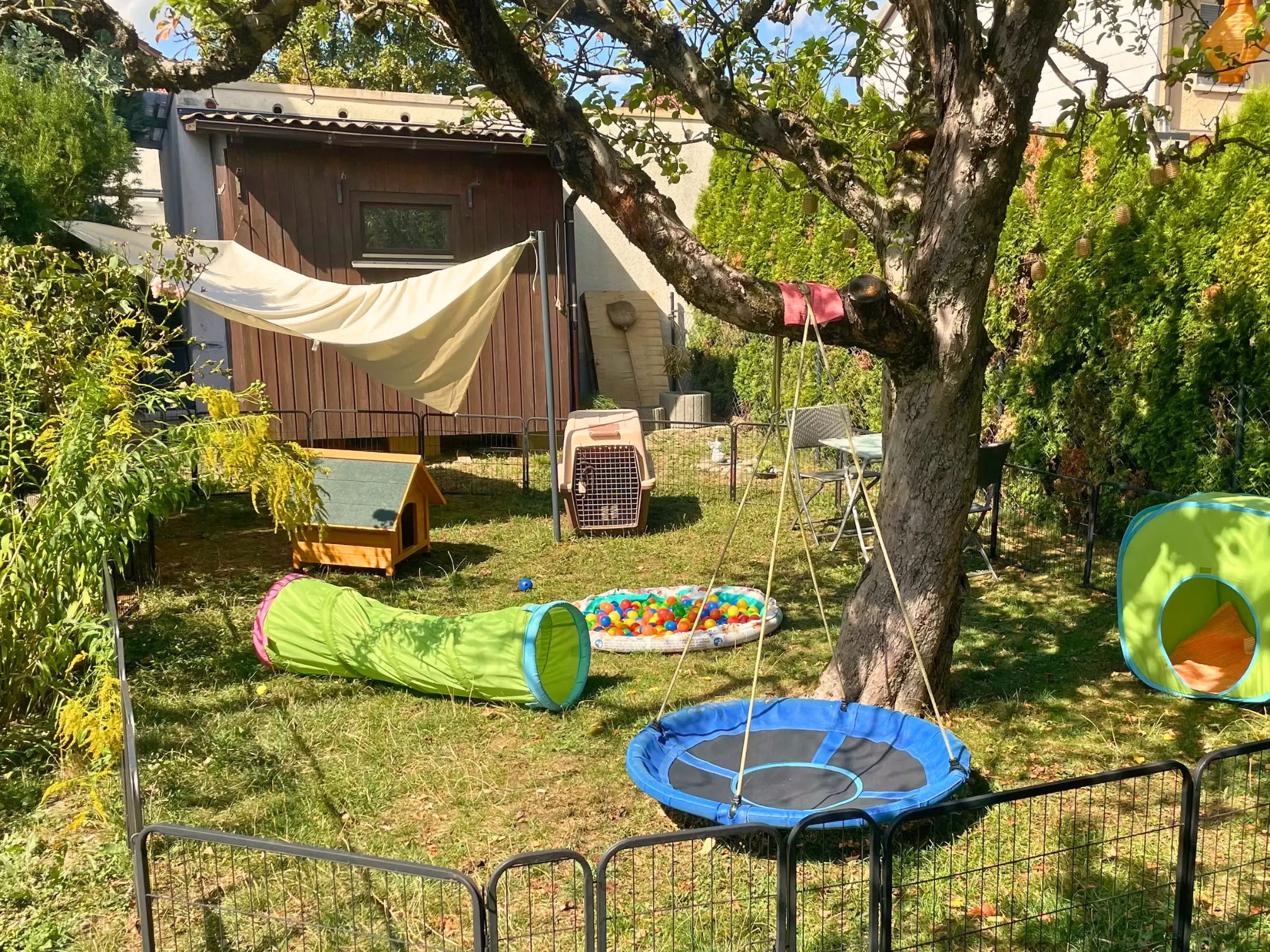
Some things should ideally feel completely ordinary later in life.
A good example is a transport crate. We therefore make a standard enclosed transport crate, similar to the type used for air travel, freely accessible within the puppies’ environment.
They can walk inside, investigate it or simply choose to sleep there.
This means they do not encounter this type of crate for the first time when facing a longer car journey, a veterinary visit or perhaps even a flight. At first, it is simply another normal part of their environment.
Exploring rather than completing exercises
Despite all these examples, raising our puppies is not about following a timetable filled with exercises.
New objects appear, their environment changes and the puppies are given opportunities to investigate things for themselves. At the same time, there is plenty of time for sleep, rest, their mother and growing up alongside their littermates.
Individual differences often become noticeable quite early. One puppy may immediately investigate something new, while another prefers to watch from a short distance first. We see these differences as a normal and valuable part of their development.
This is also why we are careful about making big claims regarding early neurological stimulation. Scientific evidence does not clearly show that one particular programme necessarily produces better results than regular, careful handling. Those interested in the research can read this scientific study on Early Neurological Stimulation in puppies.
Many small experiences instead of a packed schedule
For us, Puppy Culture is therefore not a single training exercise or a checklist that needs to be completed as quickly as possible.
It is reflected in many small situations: becoming comfortable with having their paws handled, experiencing different sounds, meeting children, exploring a balance cushion or discovering an open transport crate. At the same time, their environment gradually becomes larger and more varied as their abilities and curiosity develop.
We cannot prepare a puppy for every situation they will encounter later in life. Nor is that our goal.
What we can do is give them many positive first experiences that their new families can continue to build on.
That is what thoughtful and caring puppy raising means to us.