
Once you have decided on a puppy, another question usually follows quite quickly: Male or female?
There is no simple answer.
There are, of course, practical differences. A female comes into season, while a male may react very strongly to females in season. Average size and build can also differ.
When it comes to personality, however, things become much less clear.
Are there typical personality differences?
Research does find some average behavioural differences between male and female dogs. A review of sex differences in dog behaviour summarises several tendencies reported across different studies:
On average, males were more likely to show:
- greater boldness or confidence
- certain forms of aggressive behaviour
- more social play with humans
- in some studies, less fearfulness towards strangers or unfamiliar situations
On average, females were more likely to show:
- stronger orientation towards humans during cooperative tasks
- more human-directed social contact in some studies
- greater focus on individual social or physical stimuli
- higher caution or fearfulness in some studies
These are statistical tendencies, not fixed personality traits linked to sex. Not every study finds the same differences, and factors such as breed, age, upbringing, experience and individual personality can be just as important.
Our own dogs demonstrate this quite well.
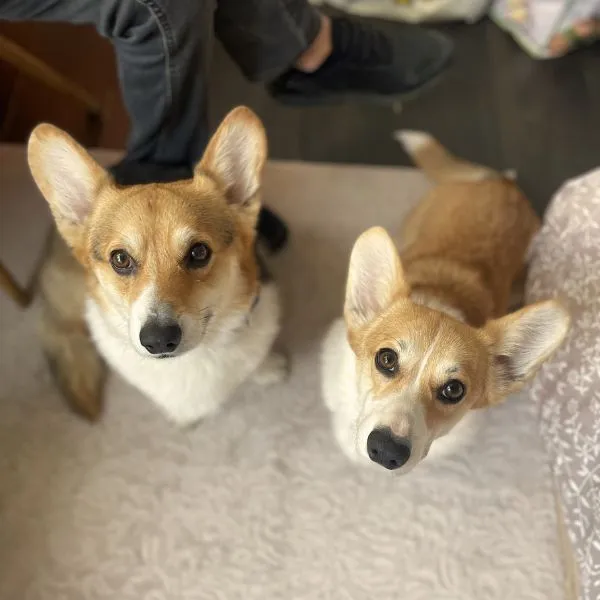
Koda was noticeably calmer, more cuddly and more focused on his person. At the same time, he could be extremely stubborn. Coco is more energetic, independent and much easier to get excited about an activity.
Whether those differences came from sex or simply from Koda being Koda and Coco being Coco is impossible to determine from two dogs.
What about neutered or sterilised dogs?
This also needs to be considered when comparing males and females.
With neutering through removal of the gonads, the organs producing the sex hormones are removed and the hormonal environment changes. Sterilisation only prevents reproduction while leaving the hormone-producing organs intact.
Research suggests that neutering can reduce some sexually motivated behaviours, such as roaming or mounting. Findings for traits such as fearfulness, confidence or aggression are much less consistent. Some studies, for example, have reported lower boldness or increased fearfulness and reactivity in neutered dogs.
Neutering therefore does not automatically make a dog calmer or easier to live with. The research is complex and does not allow a simple prediction of how an individual dog’s personality will change.
A broader overview can be found in this review of neutering and canine behaviour.
Where sex really makes a difference in everyday life
The practical differences are much easier to identify.
Below, we sometimes refer to intact dogs. By this, we mean dogs whose hormone-producing reproductive organs have not been removed through neutering.
A female regularly comes into season. During that time, contact with males can become much more difficult or may need to be avoided altogether. Walks often require more planning, off-lead time may need to be restricted and activities such as training classes can become more complicated.
Coco, for example, tends to become calmer and sometimes more affectionate during her season.
With a male, there is a different issue: females in season nearby.
When a nearby female is in heat
This was sometimes very obvious with Koda.
One of his best dog friends was a Dachshund called Ypsi. When she was in heat, Koda would sometimes sit by our door and whine. At first, I assumed he urgently needed to go outside.
Once outside, however, he would head rather purposefully towards Ypsi’s house and wait there in the hope that she might appear.
Even on normal walks, he could suddenly decide that he did not want to move on from that spot. During those periods, he sometimes ate less, pulled more and was noticeably harder to motivate with anything else.
This highlights a difference that people rarely consider beforehand.
With a female, you know when her own heats occur. With a male, the practical impact depends heavily on how many females live nearby and how strongly he reacts to them.
If there are hardly any females around, this may barely affect daily life at all. In an area with many dogs, however, different females may come into heat one after another. A particularly sensitive male may therefore be affected for longer overall than an individual female is by her own heat.
That is why we would not describe either sex as automatically more convenient.
Marking is not just a male behaviour
Koda marked a lot outside.
A short walk could easily take longer because apparently every second interesting blade of grass still required a message.
When Coco was younger, I often thought: how practical. Go outside, pee, done.
By now, she marks noticeably more as well.
Marking is therefore not exclusively a male behaviour. It is part of dogs’ social communication and can occur in both sexes. In intact males, however, it can be especially noticeable in connection with sexual communication.
Multi-dog households: the dog already living there matters
If there is already a dog in the household, we would consider sex more carefully than when choosing a single dog.
Same-sex combinations can of course work extremely well. At the same time, relationships can change as dogs reach sexual maturity.
We experienced this with Koda and his half-brother. As young dogs, they got along very well. As they matured, the dynamic between them became considerably more difficult.
We would never take that to mean that two males are inherently problematic. Instead, it shows why the existing dog, individual personalities, age and sex should all be considered together.
With an intact male and an intact female, there is another factor: managing seasons.
Koda sometimes noticed changes weeks before Coco’s actual season began. During the relevant phase, the two obviously had to be separated reliably.
Male or female as a first dog?
We would not base the decision primarily on sex.
Either can work very well.
The more important question is: Which puppy’s personality best suits the future home?
The Pembroke Welsh Corgi Club of America also recommends looking more closely at the individual puppy’s temperament rather than choosing solely by sex.
A quieter family may be happier with a more settled puppy than with the most active dog in the litter, regardless of whether that puppy is male or female. A more active and experienced household may be an excellent match for a more confident or energetic puppy.
That is why we think it is more useful to tell a breeder not only “I definitely want a female”, but also what everyday life looks like and which qualities you hope for in your dog.
More affectionate males, easier females?
Two statements come up especially often: “Males are more cuddly.” “Females are easier to train.”
Our personal experience would partly support the first one. Koda was noticeably more cuddly and more strongly focused on his person than Coco.
Even so, we would never choose a male for that reason alone.
Training was not that simple either. Koda could challenge rules very persistently. Coco, particularly during adolescence, was much more chaotic, energetic and independent.
Both were challenging in different ways.
That is why we would treat statements like these as possible tendencies or personal experiences rather than as a reliable way to choose an individual puppy.
And what would we choose ourselves?
Our own situation shows quite well why there is no universal answer.
From a personality perspective, I would absolutely love to live with a male again. I especially miss Koda’s calm, cuddly and very people-oriented nature.
For our household right now, however, another female would probably be the better fit.
We already live with an intact female. An intact male would make managing her seasons considerably more complicated. Our breeding plans also naturally play a role.
So our decision would not be: Females are better.
It would simply be: A female currently fits our household and our plans better.
So: male or female?
If someone asked me today, my answer would probably be: It depends on what you want and what your everyday life looks like.
A male does not automatically mean dominance, chaos and uncontrollable hormones. A female is not automatically gentler, easier or simpler to train.
The practical differences are worth understanding. Seasons, sexual interest, marking behaviour and compatibility with dogs already living in the household can all matter in daily life.
When actually choosing a puppy, however, we would place at least as much importance on friendliness, confidence, ability to settle, activity level, orientation towards people and health.
Because in the end, you are not simply bringing home “a male” or “a female”.
You are bringing home one particular dog with an individual personality.